
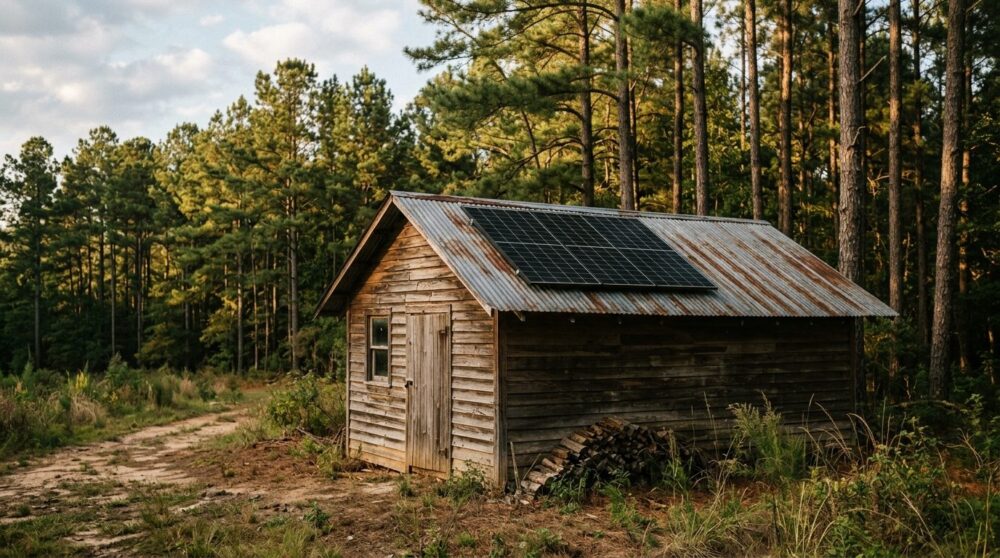
Yes, you can use a 400 watt solar panel on a 12V battery, and a 540-watt one too, as long as it charges the battery through an MPPT charge controller rated for that panel’s voltage and wattage. One panel on a properly sized MPPT is almost always fine. Two panels wired in series is where folks get into trouble. Whether that works depends on how many cells the panels have and how cold your corner of Georgia gets on a clear January morning.
Most answers to this question stop at a rule of thumb, something like a few hundred watts per 12V battery and five sun hours a day. The catch is that most panels sold as 12V-compatible today are full-size home modules with 96, 108 or 144 cells and open-circuit voltages from about 35 to 50 volts. With panels like that, the controller’s voltage limit decides what you can wire. The battery hardly enters into it.
Why a regular home solar panel can charge a 12V battery
The five panels in the table further down have open-circuit voltages (Voc) between 35.03 and 49.5 V, while a 12V lithium battery is 12.8 V nominal. An MPPT (maximum power point tracking) controller lets the panel run near its best voltage and turns the surplus voltage into extra charging current on the battery side.
A PWM controller can’t do that conversion. It connects the panel more or less straight to the battery, so a 40-volt panel gets pulled down to battery voltage and most of what it could produce never turns into charge. For any 96-, 108- or 144-cell panel on a 12V battery, I’d leave PWM off the shopping list.
An MPPT has a floor as well as a ceiling. Victron’s manual for the SmartSolar 100/30 puts it plainly: “The PV voltage must exceed Vbat + 5V for the controller to start.” After start-up it keeps working down to battery voltage plus 1 V. With a 12.8 V battery that’s about 17.8 V to wake up, and a 35-to-50-volt panel clears that easily. The ceiling is what causes trouble.
How many watts a 12V MPPT controller can take
Two ratings matter for a big panel: the highest PV voltage the controller can accept and the most power it can push into a 12V battery. Here are the two Victron SmartSolar models people usually weigh for this job, from Victron’s manuals for the 100/30 and the 150/35.
| Spec | SmartSolar MPPT 100/30 | SmartSolar MPPT 150/35 |
|---|---|---|
| Battery voltage | 12 or 24 V, auto-select | 12/24/48 V auto-select (36 V manual) |
| Max charge current (A) | 30 | 35 |
| Nominal PV power at 12 V (W) | 440 | 500 |
| Max PV open-circuit voltage (V) | 100 | 150 |
| Max PV short-circuit current (A) | 35 | 35 |
| Full rated output up to | 40°C (104°F) | 40°C (104°F) |
Extra wattage is the forgiving part. Victron’s 150/35 manual says the charger limits input power when more PV is connected, so a 540 W panel on a 12V 150/35 gets held back to what the controller can handle on the brightest afternoons. The 100/30 is held to its 30 A charge rating. Voltage gets no such allowance: 100 V and 150 V are listed as maximums, and I wouldn’t design anything that comes near them.
On a 12V battery, one 440 W panel already matches the 100/30’s 440 W nominal rating, so a second big panel won’t double your summer charging. The controller can’t pass it through. What a second panel does buy you is more charge on short, gray winter days, when each panel makes well under its rating. That can be worth it at a camp you mostly use in December. Just know that’s what you’re paying for.
Which panels fit which controller
Whether a panel fits a 100 V or a 150 V controller comes down to its Voc, and the five full-size panels below cover the usual range. Voc and prices are from a retailer’s 12V-compatible panel listing as seen on November 20, 2026 (linked in the buying section below). The two-in-series verdicts account for Georgia winter cold, which the next section works through.
| Panel | Cells | Voc, 1 panel (V) | Voc, 2 in series at 25°C (V) | 1 panel, either controller | 2 in series on 100/30 (100 V max) | 2 in series on 150/35 (150 V max) | Price per watt, Nov 20, 2026 |
|---|---|---|---|---|---|---|---|
| Solarever 450 W SE-182*105-450M-96-BD | 96 | 35.03 | 70.06 | Fits | Fits, wide margin | Fits | $0.39 |
| JA Solar 440 W JAM54D41-440/MB | 108 | 39.38 | 78.76 | Fits | Fits: 87.5 V at −3.1°F | Fits | $0.41 |
| Phono Solar 440 W PS440M8GFH-18/VNHB | 108 | 39.61 | 79.22 | Fits | Likely fits; confirm the coefficient | Fits | $0.40 |
| Canadian Solar 355 W CS3U-355PB-AG | 144 | 46.8 | 93.6 | Fits | Too close; use 150 V | Fits | $0.30 |
| LONGi 540 W LR5-72HBD-540M | 144 | 49.5 | 99.0 | Fits | No: 105.6 V at 32°F | Fits: 110.7 V at −3.1°F | $0.33 |
I only have verified Voc temperature coefficients for the JA and the LONGi, so the other three verdicts are based on how much margin they have, not on a full calculation. Two Phono panels start at 79.22 V. It would take a coefficient of about −0.59%/°C, more than twice the JA’s, to push them past 100 V at Blue Ridge’s 2014 low. Two Canadian Solar 355s start at 93.6 V, which leaves under 7% of room. At Atlanta’s 4.1°F, any coefficient steeper than about −0.17%/°C uses that up, and both coefficients on this page are steeper. Pull the datasheet before you wire either one.
Wiring in series doesn’t add current, so a two-panel string carries one panel’s short-circuit current (Isc). The 35 A Isc limit only becomes a real question if you wire in parallel, covered in the questions at the end.
The Georgia cold-morning voltage check
A panel’s open-circuit voltage rises as its cells get colder. The highest voltage your controller will ever see comes on a clear, frigid morning when the sun first hits the glass and the cells are still at air temperature. Datasheet Voc is measured at 25°C (77°F), so you correct it for your coldest morning:

Voc (cold) = Voc (25°C) × [1 + |coefficient| × (25 − Tmin)], with Tmin in °C and the coefficient as a decimal per °C.
For real Georgia lows, I’d use January 2014. UGA’s weather stations recorded 4.1°F in Atlanta on January 7 and −3.1°F at Blue Ridge on January 6, the lowest UGA reading of that cold snap (UGA CAES Field Report). Rome and Gainesville hit 5.6°F, Tifton 15.4°F and Brunswick 19.4°F, and a Forest Service station on Brasstown Bald read −6°F.
Two LONGi 540 W panels in series. 2 × 49.5 V = 99.0 V at 25°C, a hair under the 100/30’s limit before any cold at all. The LONGi’s Voc coefficient is −0.265%/°C (EnergySage). On a plain 32°F (0°C) morning, that’s 99.0 × (1 + 0.00265 × 25) = 99.0 × 1.066 = 105.6 V. At Atlanta’s 4.1°F (−15.5°C), it’s 99.0 × (1 + 0.00265 × 40.5) = 99.0 × 1.107 = 109.6 V. Even the coast’s 2014 low, 19.4°F at Brunswick, works out to 107.4 V. I can’t name a spot in Georgia where two of these on a 100 V controller would be safe. On a 150/35 they’re fine: Blue Ridge’s −3.1°F gives 110.7 V.
Two JA Solar 440 W panels in series. 2 × 39.38 V = 78.76 V at 25°C, and the JA’s Voc coefficient is −0.25%/°C (Portlandia Electric Supply). At Blue Ridge’s −3.1°F (−19.5°C), that’s 78.76 × (1 + 0.0025 × 44.5) = 78.76 × 1.111 = 87.5 V, leaving 12.5 V under the 100 V limit. Brasstown Bald’s −6°F (−21.1°C) only raises it to about 87.8 V. Add a third JA, though, and you’re at 118.1 V on a mild day, over 100 V before the weather even matters.
| Series string | Voc at 25°C (V) | 32°F / 0°C | Brunswick 19.4°F / −7.0°C | Atlanta 4.1°F / −15.5°C | Blue Ridge −3.1°F / −19.5°C |
|---|---|---|---|---|---|
| 1 × LONGi 540 W (−0.265%/°C) | 49.5 | 52.8 | 53.7 | 54.8 | 55.3 |
| 2 × LONGi 540 W | 99.0 | 105.6 | 107.4 | 109.6 | 110.7 |
| 2 × JA Solar 440 W (−0.25%/°C) | 78.8 | 83.7 | 85.1 | 86.7 | 87.5 |
| 3 × JA Solar 440 W | 118.1 | 125.5 | 127.6 | 130.1 | 131.3 |
Victron says the same thing in its MPPT documentation, warning that in the cold a 144-cell array’s open-circuit voltage can go over 100 V, depending on local conditions. The 2 × LONGi row shows that happening in Georgia.
And 2014 wasn’t the floor. Georgia’s all-time record low was set on January 27, 1940, in the area of northwest Georgia called The Pocket, at a Civilian Conservation Corps camp in or near northern Floyd County (UGA Extension Climate blog). UGA’s post doesn’t give the temperature, and I won’t guess it. If you’re in the mountains, run the formula with a number colder than the 2014 lows and see whether your string still clears the limit.
What one 440 W panel puts into a 12V battery in December and June
In Atlanta, one 440 W panel puts back a bit less than one full 100Ah lithium battery a day in December, and about 1.7 batteries’ worth a day in June. Those figures come from NREL’s PVWatts model as reported by The Green Watt, a secondary source. For a 400 W panel facing due south at a 20° tilt with 14% system losses, it lists about 32 kWh in December, 34 in January, and 60 in both May and June (The Green Watt).
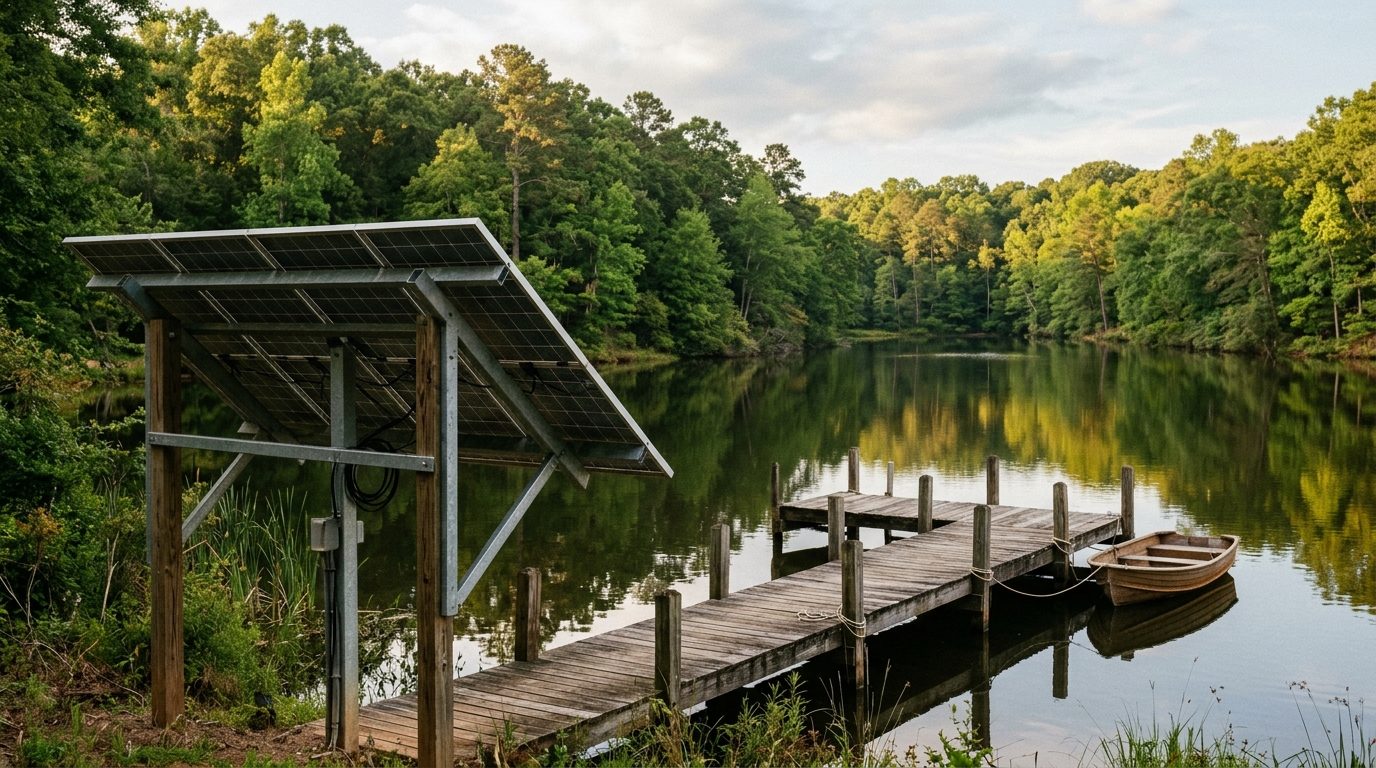
> Rough math: one 440 W panel, one 12V battery, Atlanta > > – Size. Battery: 12.8 V × 100 Ah = 1.28 kWh. Panel: one JA Solar 440 W, which matches the 440 W nominal rating of a Victron 100/30 at 12 V. > – December. 32 kWh ÷ 31 days = 1.03 kWh a day for 400 W. Scaled to 440 W (× 1.1), that’s about 1.1 kWh a day, roughly 0.9 of the battery. > – June. 60 kWh ÷ 30 days = 2.0 kWh a day for 400 W, or about 2.2 kWh for 440 W. That’s 1.7 times what the battery holds, so the controller cuts back once the battery is full. > – Cost. The panel was listed at $178.94 ($0.41/W) on November 20, 2026. The controller, battery, wire and mounting come on top of that. > – Payback. Payback doesn’t really apply here. A shed battery doesn’t offset a power bill. You’d compare the panel and battery against trenching a circuit out from the house or running a generator. > – Assumptions. PVWatts figures via The Green Watt, Atlanta, south-facing, 20° tilt, 14% losses, no shade. These are monthly averages. A cloudy week in December will run well under them.
The same source puts Atlanta at 5.17 peak sun hours a day averaged over the year, but only 3.45 in December against 6.63 in June. That December figure is about a third below the five-hours-everywhere rule, and December is the month that decides whether your battery keeps up.
All of this assumes an unshaded panel. Plenty of sheds and camps in north Georgia sit under pines or hardwoods, and the low December sun throws long shadows across a spot that looked wide open in July. Shade does the most damage in the month you’re sizing for, so I’d check the site on a winter afternoon before mounting anything. If you’re weighing panels for a house in the city instead, the Atlanta page covers rooftop solar there.
Georgia heat and the charge controller
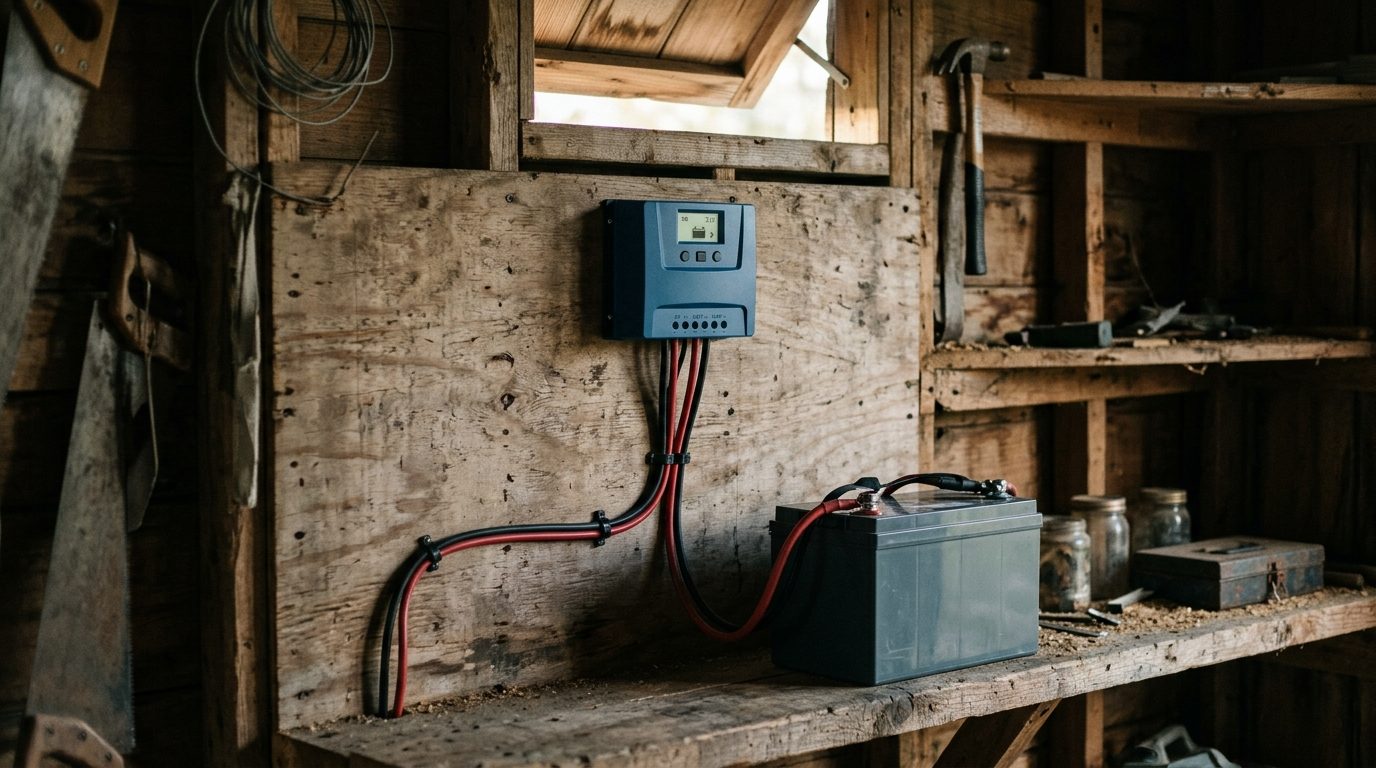
Victron rates both the 100/30 and the 150/35 for full output only up to 40°C (104°F). The 100/30’s operating range runs from −30°C to +60°C, about −22°F to 140°F (Victron). A closed-up shed on an August afternoon can get past 104°F, and that’s when the panel is producing the most. I’d mount the controller on an inside wall, out of direct sun, with space around it and some way for hot air to get out of the building.
Heat also cuts what the panel produces. The JA’s Pmax temperature coefficient is −0.29%/°C (Portlandia Electric Supply) and the LONGi’s is −0.34%/°C (EnergySage). So every 10°C the cells run above 25°C costs about 2.9% of rated power on the JA and 3.4% on the LONGi. A dark panel in full July sun runs a good deal hotter than the air around it, so midday summer output stays below the label even on a clear day.
And come April, when pine pollen turns every truck in the county yellow, it’ll coat your panel too. Hose it off.
Where to compare full-size panels for a 12V build
In this snapshot from November 20, 2026, prices ran from $0.30 to $0.41 per watt. Prices move, so treat these as a dated reference, not a quote.
| Panel | Watts (W) | Listed price | Was | Price per watt |
|---|---|---|---|---|
| Canadian Solar CS3U-355PB-AG (clearance) | 355 | $107.24 | $118 | $0.30 |
| LONGi LR5-72HBD-540M | 540 | $179.01 | $190 | $0.33 |
| Solarever SE-182*105-450M-96-BD | 450 | $177.12 | $213 | $0.39 |
| Phono Solar PS440M8GFH-18/VNHB | 440 | $177.41 | — | $0.40 |
| JA Solar JAM54D41-440/MB | 440 | $178.94 | $190 | $0.41 |
If you want to compare current prices and check each module’s Voc before you choose a controller, the 12V-compatible panel listings at A1 Solar Store show price per watt and open-circuit voltage side by side; as of November 20, 2026, a 440 W 108-cell JA Solar module was listed at $178.94. The category showed 101 results that day and lists a pickup location in Pooler, GA, which may suit you better than having a 7-foot panel freighted out to a farm road.
The lowest price per watt doesn’t always mean the cheapest build. The LONGi 540 is a good deal per watt, but two of them in series means buying the 150 V controller. The panel itself measures 2256 × 1133 mm, about 7.4 by 3.7 feet (EnergySage), and weighs 71.21 lb (Portlandia Electric Supply). That’s a lot of glass for a deer-stand roof or a dock post. If you’re comparing the same panels for a grid-tied roof, the site’s solar panels overview covers that use.
When a 12V off-grid setup makes sense
A 12V off-grid setup makes sense when the load is small and the spot is a long way from the meter. Think lights and a fan in a barn, a dock light, a gate opener, or a camp where you charge phones and run a few LED lights. A standalone 12V system never connects to Georgia Power’s or your EMC’s lines, so the utility isn’t involved at all. Running a buried circuit out to a far corner of the property can cost more than a panel, a controller and a battery.
It makes less sense as storm insurance for the house. A 12.8 V 100Ah battery holds 1.28 kWh, and that won’t keep a refrigerator and a well pump going for days after a summer storm takes the power out. If that’s what you’re really after, whole-home backup is a separate project, and the site’s solar batteries page is a better place to start.
Wherever the panel goes, a 7-foot sheet of glass catches a lot of wind. Mount it for the worst thunderstorm you’ve seen come through, not an average one.
Questions people ask
Can I use a PWM controller with a 72-cell panel?
I wouldn’t. A 72-cell panel, sold today as 144 half-cells like the LONGi and Canadian Solar above, has a Voc in the high 40s. A PWM controller drags that down to battery voltage, so you’d pay for a 540 W panel and get a fraction of it. If you already own a PWM unit, check its maximum input voltage before connecting anything.
Can I wire two panels in parallel instead of series?
Yes, and on a 100/30 it’s the way to use two 144-cell panels. Parallel keeps the voltage at one panel’s Voc, so two LONGi 540s stay around 55 V even at Blue Ridge’s −3.1°F. Current adds instead, so add up both panels’ short-circuit current from the datasheet and check the total against the controller’s 35 A limit. The 440 W nominal rating still applies, so two 540s in parallel on a 12V 100/30 will spend most of the summer held back by the controller.
How many panels do I need for a 100Ah battery?
For a 12.8 V 100Ah battery in Atlanta, one unshaded 440 W panel puts back about 1.1 kWh a day in December, against the battery’s 1.28 kWh. If your camp drains the battery most of the way every winter day, I’d look at a second panel or a smaller load. For a shed that gets used on weekends, one panel has the rest of the week to catch up.
Can a lithium battery charge below freezing?
Check your battery’s datasheet for its minimum charging temperature. Many lithium iron phosphate batteries aren’t meant to take a charge below freezing, and some include heaters or a low-temperature cutoff. A shed in Blairsville, which hit −1.8°F in January 2014, will get that cold, and so will plenty of places south of it.
What I’d do
For a shed, barn, dock or camp on a 12V battery, I’d buy one 108-cell panel around 440 W and a 100 V MPPT like the 100/30, then stop unless December proves it short. If I wanted two big panels, I’d either stick with 108-cell modules and run the cold formula with my own area’s worst morning, or go straight to a 150 V controller. I’d never put two 144-cell panels in series on a 100 V controller anywhere in Georgia, however mild last winter was. Prices and specs here are as of November 20, 2026, so check the current listing and the panel’s own datasheet before you wire anything.